 $12,022 a year
$12,022 a year
$12,022 a year

That is what diabetes costs an American every single year, on top of everything else. The medicine that can prevent it already exists, and the price you pay depends entirely on which side of the border you buy it. Here is all of it: what it does, what it really costs, and where you are being overcharged.
If you do not have time for the full essay, this explains all of it in 56 seconds.
If you have type 2 diabetes in the United States, you spend $12,022 more per year on health care than someone who does not. Every year. For the rest of your life.
Nationally, the disease costs $412.9 billion a year. That is the American Diabetes Association's own figure.
Against that wall, between December 2025 and July 2026, results were published for a drug most people have not read in full.
I am going to explain what it is, how it works, and why it pays to understand it now rather than from a hospital bed.
Run that over twenty years and you are looking at a quarter of a million dollars. That is a house down payment, a college fund, a retirement.
And that figure counts only the bills. It does not count the years.
Two minutes on how your body works. Without this, none of the rest lands.
Your body runs on chemical messengers. We call them hormones, and many are peptides: short chains of amino acids.
Think of them as your body's text messages. Short, precise, addressed to someone.
When you eat, your gut sends one of those messages. It is called GLP-1 and it says three things at once:
The catch is that the natural message lasts minutes. Science learned to build versions that last a week.
That is Ozempic. That is Wegovy. One message, one pedal: the appetite brake.
Here is the first thing that changes everything: satiety stopped being a question of willpower.
The phrase you will hear more and more, explained once and properly.
Mounjaro added a second messenger, GIP, which improves how you process sugar and fat after eating. Two pedals. That alone produced losses of up to 21 percent.
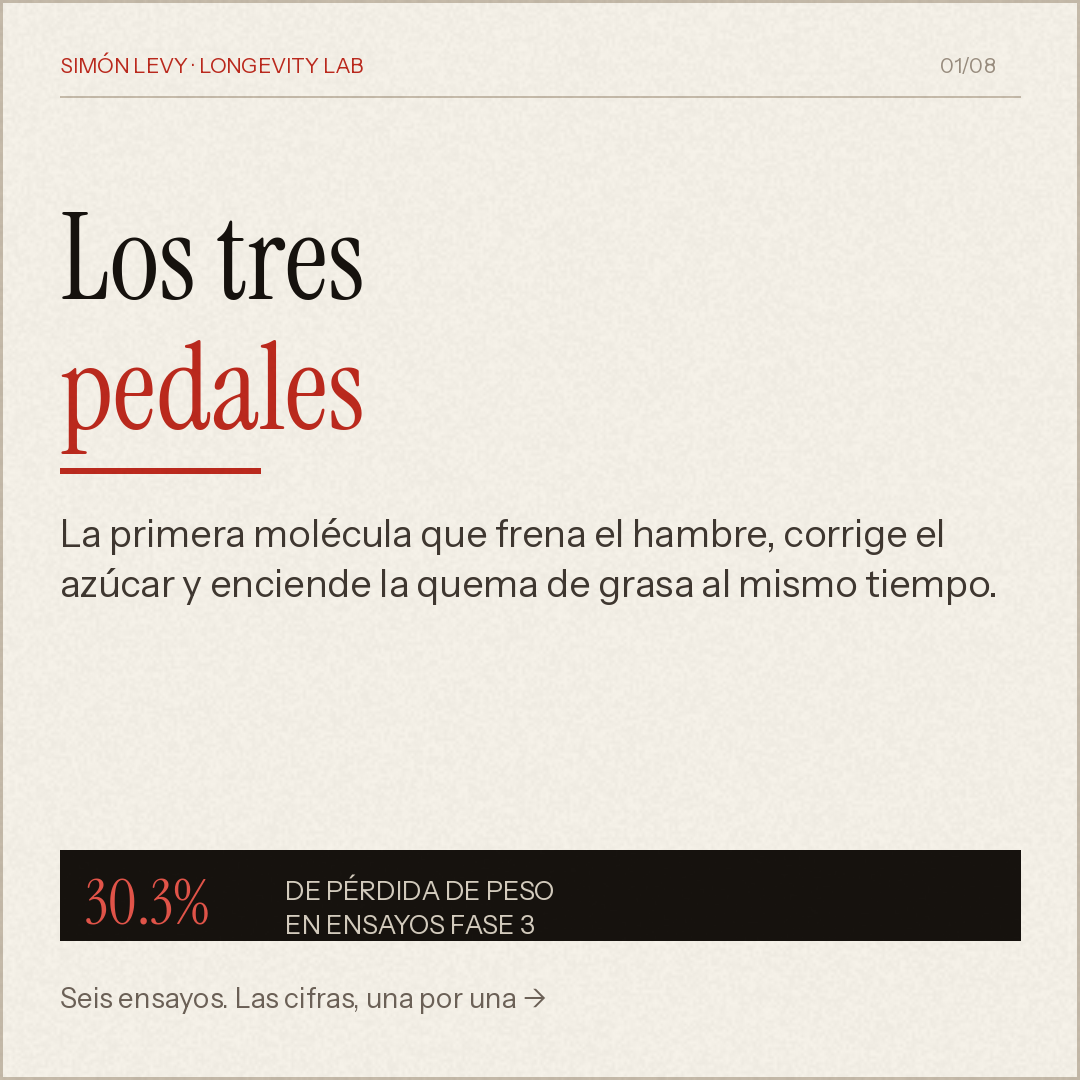
Retatrutide, from Eli Lilly, is the first molecule that activates three receptors at once: GLP-1, GIP and glucagon.
The word agonist simply means activator. It is a manufactured key that opens the same lock as the natural hormone. Nothing more.
And the third messenger, glucagon, is what changes the game: it is the spend switch. It orders the liver to burn its own fat and raises whole-body energy expenditure.
Tap each molecule to see what it does and how much weight it removed in trials.
Everything below comes from phase 3 trials: the highest evidence standard, thousands of patients, placebo-controlled. None of this is a promise.
An honest caveat, and I will repeat it because it matters: retatrutide is not approved anywhere. Lilly will file with the FDA in the first quarter of 2027. More phase 3 readouts land this year, including a cardiovascular and renal study of roughly 10,000 patients.
Sources: Eli Lilly and Company topline releases for TRIUMPH-4 (December 11, 2025), TRIUMPH-1 (May 21, 2026), TRIUMPH-2 and TRIUMPH-3 (July 23, 2026). Sleep apnea substudy presented at the American Diabetes Association Scientific Sessions (June 6, 2026). TRANSCEND-T2D-1 (topline March, publication June 2026). Phase 2 published in the New England Journal of Medicine (June 2023).
Here is the reading that actually matters, and almost nobody makes it.
A diabetes diagnosis at age 30 cuts up to 14 years off life expectancy. That comes from the analysis published in The Lancet Diabetes and Endocrinology in 2023.
Fourteen years. That is not a pants-size conversation.
Visceral fat, the kind wrapped around your organs, is not an inert deposit. It behaves like an inflamed organ, bombarding your arteries, your liver and your brain with inflammatory signals every day, around the clock.
And this whole peptide family has already shown what happens when that bombardment stops:
If you lose 25 percent of your body weight without enough protein and without resistance training, part of what you lose will be muscle. And muscle is the organ of longevity.
A drug without habits is an expensive loan. Withdrawal trials show that without behavior change, most of the weight returns within a year of stopping.
Now the calculation this essay promised in its first line.
In the United States, a person with diabetes spends $12,022 extra per year on medical care. The disease costs the country $412.9 billion annually. American Diabetes Association, 2023.
Against that, current U.S. list prices for approved peptides run roughly like this in 2026, before insurance and manufacturer coupons:
Now put the two side by side. A dialysis patient in the U.S. costs Medicare roughly $100,000 per year. A major cardiovascular event runs $50,000 to $80,000 in year one alone.
Compare a year of treatment against a year of the complication you might avoid. Move the controls.
Educational estimate using published U.S. figures (American Diabetes Association 2023; Medicare ESRD cost data) and 2026 pricing. Does not predict individual outcomes and does not replace medical advice. Treatment does not guarantee avoiding complications.
Semaglutide's patent has already expired in India. By late 2026 it will have expired in 10 countries representing 48 percent of the global obesity burden, with more than 50 generic brands on the way.
Add to that the first oral in this family, orforglipron, already branded Foundayo: no needle, no refrigeration, built for mass production.
Retatrutide is the leading edge of something much larger.
Coming next: combinations with amylin, the pancreatic hormone that reinforces satiety. Monthly versions instead of weekly. Duals aimed specifically at fatty liver disease.
Nearly every organ you have carries receptors for these hormones. That is why trials keep appearing in knees, kidney, heart, liver and sleep. Addiction and brain health are already being explored.
We are where antibiotics were in the 1940s: the first generation of a drug class that will reorganize medicine itself.
Same laboratory, same molecule, same box. The price changes depending on which side of the border you buy it.
Same laboratory, same molecule, same presentation. Tap each medicine.
That is not a tax or an import cost. It is what can be charged when the buyer is desperate and has nothing to compare against.
Retatrutide is not legally sold anywhere. That has not stopped it from being sold.
Vials circulate labeled as research material, offered through social media and messaging apps, at prices reaching $800 per month. Here is what that buys:
Longevity Lab members get access to partner clinics in San Diego, with physician consultation, prescription and follow-up included. The legal route, with a California-licensed physician and pharmacy-sourced product.
Access applies to active Longevity Lab members. Clinical eligibility is determined by the treating physician, not by membership. Prescription is not guaranteed. Prices may vary by dose and presentation.
This section is short and it is the most important one here.
Retatrutide is not legally for sale in any country. Research vials sold online have no quality control, no dose verification and no sterility guarantee.
Health agencies including the FDA have already warned about counterfeit versions of the peptides that are approved. Do not buy your health on the gray market.
Approved peptides require a prescription and medical supervision. They carry frequent gastrointestinal effects, gallbladder and heart-rate precautions, and are not used in pregnancy.
Your physician decides. This essay only gives you the map.
Here is what I would do starting from zero, in order.
Nobody improves what they do not measure. Fasting glucose, HbA1c, fasting insulin, lipid panel, liver enzymes. Without those five numbers, every decision is blind.
I built a calculator that estimates how many healthy years your habits, medications and supplements add, organ by organ, using available human evidence. It is called Vida Posible and you can try it free once.
Try Vida PosibleThe Longevity Lab has the full protocols, every calculator, the AI chat and the community.
Enter the Longevity LabDisclaimer. This essay is educational and does not constitute medical advice. Retatrutide is an investigational drug, not approved by any regulatory agency. All treatment decisions must be made with a physician. Figures cited come from the sources listed on the dates indicated and may be updated by new publications.